Return to Memolist
MMA Memo 139: Fast Switching Phase Calibration:
Effectiveness at Mauna Kea and Chajnantor
M.A. Holdaway, Simon J.E. Radford, F.N. Owen, and Scott M. Foster
National Radio Astronomy Observatory
September 26, 1995
Abstract:
We present estimates of how well fast switching phase calibration would
perform at the Chajnantor, Chile, and Mauna Kea VLBA sites. Fast
switching at Chajnantor would achieve better than 30 r.m.s.
phase
errors at 230 GHz about twice as often as at Mauna Kea. We
also investigate how the residual phase errors depend upon the slew
speed of the antennas
(0.5
r.m.s.
phase
errors at 230 GHz about twice as often as at Mauna Kea. We
also investigate how the residual phase errors depend upon the slew
speed of the antennas
(0.5 s
s through 2.0
 s
s ). At 230 GHz, faster
slewing provides a significant improvement in the fraction of time the
array will be able to achieve 30
). At 230 GHz, faster
slewing provides a significant improvement in the fraction of time the
array will be able to achieve 30 r.m.s. residual phase errors. At
690 GHz, faster slewing will provide two or three times more observing
time available with 30
r.m.s. residual phase errors. At
690 GHz, faster slewing will provide two or three times more observing
time available with 30 r.m.s. residual phase errors. Increasing
the total continuum bandwidth from 4 GHz to 16 GHz provides a marginal
improvement in the residual phase errors.
r.m.s. residual phase errors. Increasing
the total continuum bandwidth from 4 GHz to 16 GHz provides a marginal
improvement in the residual phase errors.
The primary goal of site testing is to compare site characteristics,
such as opacity and phase stability, that will influence astronomical
observing. A secondary goal is to predict with some confidence how
well various observing strategies, such as fast switching phase
calibration, will work. The data analysis for the site test
interferometer was outlined in MMA Memo 129 (Holdaway, Radford, Owen,
and Foster 1995), and residual phase errors after fast switching were
analyzed in MMA Memo 126 (Holdaway and Owen 1995). Here we use the
most current estimates of the distributions of the phase structure
function and velocity aloft at Chajnantor, Chile, and at the
Mauna Kea VLBA site to provide a better picture of how well fast
switching will work at these sites.
The analysis of the fast switching phase calibration performed here is identical
to the analysis described in MMA Memo 126, but we have changed a number
of the input parameters in this work. The differences between the
previous work and this work are summarized below:
- The current work uses distributions of the phase structure
function and the velocity aloft measured with the NRAO
site test interferometers. The Mauna Kea data were obtained between
December 1994 and July 1995, while the Chajnantor data were obtained
between May 6, 1995, and August 11, 1995.
Note the data cover the season when we expect the best
conditions at Chajnantor, so
the overall distribution of the phase structure function
may degrade in the coming months.
- The median velocity aloft at both sites is very close to 12.5ms
 ,
whereas the previous analysis used a velocity of 5ms
,
whereas the previous analysis used a velocity of 5ms \
determined by Colin Masson for the summit of Mauna Kea. We
have used the data reduction path described in MMA Memo 129
(Holdaway, Radford, Owen, and Foster, 1995) to compare the
site test data for the Mauna Kea summit and the Mauna Kea VLBA
site. We found the median velocity aloft for the summit was
about 6ms
\
determined by Colin Masson for the summit of Mauna Kea. We
have used the data reduction path described in MMA Memo 129
(Holdaway, Radford, Owen, and Foster, 1995) to compare the
site test data for the Mauna Kea summit and the Mauna Kea VLBA
site. We found the median velocity aloft for the summit was
about 6ms , in agreement with Masson's result, but the
median velocity at the lower altitude VLBA
site was 12ms
, in agreement with Masson's result, but the
median velocity at the lower altitude VLBA
site was 12ms . This apparent contradiction is understood if the summit
is dominated by surface turbulence that moves across
the interferometer at close to the surface velocity while the
VLBA site is dominated by turbulence at a much higher
elevation. Larger velocities aloft result in larger residual
phase errors with fast switching.
. This apparent contradiction is understood if the summit
is dominated by surface turbulence that moves across
the interferometer at close to the surface velocity while the
VLBA site is dominated by turbulence at a much higher
elevation. Larger velocities aloft result in larger residual
phase errors with fast switching.
- The median power law index of the phase structure function
is 0.61 at Chajnantor
and 0.62 at the Mauna Kea VLBA site.
- We fixed a bug in the code that determined the optimal value of
 for each simulated calibrator field, resulting in
somewhat larger residual phase errors in most cases.
for each simulated calibrator field, resulting in
somewhat larger residual phase errors in most cases.
- We performed calculations for total continuum bandwidths of 4 GHz
and 16 GHz,
the two possibilities currently under discussion.
- We considered a range of slewing speeds and setup times:
0.5
 s
s and 2 s setup,
1
and 2 s setup,
1 s
s and 1 s setup, and 2
 s
s and 0.5 s setup.
Currently the antenna group is confident switching to a
source 1.5
and 0.5 s setup.
Currently the antenna group is confident switching to a
source 1.5 away can be accomplished in about 2 s,
roughly equivalent to 1
away can be accomplished in about 2 s,
roughly equivalent to 1 s
s and 1 s setup.
- Most simulations were performed with 2/3 of the cycle time integrating
on the target source, which increases the noise by 22% over
spending all the time on source. One set of simulations
explored how the residual phase errors depend upon the
fraction of time spent on source while fixing the time
on the calibrator.
- Sources as weak as 10 mJy were included in the Monte Carlo simulation
of the calibrator distribution.
Our site test database includes a time series of the phase structure
function amplitude, its power law exponent, and the velocity aloft.
Eventually we hope to use all of this information since these
quantities are not independent. For now, however, we have used the
full distribution of the structure function amplitude and the median
velocity and power law exponent.
The residual phase errors after fast switching phase calibration are

(MMA Memo 126), and are independent of baseline length for baselines
longer than  . Note that fast switching phase calibration
will work for arbitrarilly long baselines. The residual phase errors
can be calculated for any simulated calibrator/source configuration,
observing strategy, and instrument sensitivity. Given the
distribution of the structure function,
. Note that fast switching phase calibration
will work for arbitrarilly long baselines. The residual phase errors
can be calculated for any simulated calibrator/source configuration,
observing strategy, and instrument sensitivity. Given the
distribution of the structure function,  , we can create a
distribution of residual phase errors that includes both the
distribution of calibrators on the sky and the distribution of
atmospheric conditions. We assume acceptable images can be made with
30
, we can create a
distribution of residual phase errors that includes both the
distribution of calibrators on the sky and the distribution of
atmospheric conditions. We assume acceptable images can be made with
30 r.m.s. errors.
Figure 1 shows the distributions of residual phase
errors after fast switching calibration at Chajnantor with 16 GHz of
continuum bandwidth, corrected for 60 degrees elevation angle,
calculated for a range of simulated switching speeds. The measured
distribution of atmospheric phase fluctuations on a 300 m baseline and
the extrapolated distribution of phase fluctuations on a 1000 m
baseline are also shown. Figure 2 shows the same
distrubutions for Chajnantor with a 4 GHz continuum bandwidth and
figures 3 and 4 show the analogous data
for the Mauna Kea VLBA site. Figure 5 shows the
residual phase error distributions for the Chajnantor and Mauna Kea
sites together. Figure 6 shows the residual phase
errors improve when a smaller fraction of the cycle time is spent on
the target source, making the entire cycle faster since the
integration time on the calibrator is fixed.
-
The 16 GHz bandwidth improves fast switching only moderately.
Because the sensitivity, the typical distance to the
nearest detectable calibrator, and the phase structure function
all depend sub-linearly on the bandwidth,
increasing the bandwidth by a factor of 10 will decrease the residual
phase errors by only a factor of about 1.5. The extra bandwidth will
help most with the very small phase error case (i.e., high frequencies).
-
Switching speed is moderately important for 230 GHz and crucial
for higher frequencies. Improving the switching time for a 1
 move from 4 s (0.5
 s
s and 2 s setup) to 2 s (1
 s
s and 1 s setup)
would improve the residual phase errors at 230 GHz at Chajnantor
by about
10
and 1 s setup)
would improve the residual phase errors at 230 GHz at Chajnantor
by about
10 , making the array usable about 10% more often.
Observations at 690 GHz would require 10
, making the array usable about 10% more often.
Observations at 690 GHz would require 10 r.m.s. phase errors on our
230 GHz plots. At 690 GHz, the same improvement would
double the amount of time available for observations.
r.m.s. phase errors on our
230 GHz plots. At 690 GHz, the same improvement would
double the amount of time available for observations.
-
Fraction of time on the target source. The residual phase
errors can be reduced, to some limit, by spending a smaller
fraction of each cycle on the target source. We fixed the time
on the calibrator, so this speeds up the entire cycle.
Figure 6 shows this
effect for Chajnantor, 1
 s
s switching, and 16 GHz bandwidth.
If 30
switching, and 16 GHz bandwidth.
If 30 r.m.s.
phase errors are acceptable, spending 83% of the cycle time on the
target source (increasing the noise by 10%) will work just over half
the time. If the atmospheric conditions are marginal, reducing
the source integration to 50% of the cycle time (41%
noise increase) will permit observations with 30
r.m.s.
phase errors are acceptable, spending 83% of the cycle time on the
target source (increasing the noise by 10%) will work just over half
the time. If the atmospheric conditions are marginal, reducing
the source integration to 50% of the cycle time (41%
noise increase) will permit observations with 30 r.m.s.
phase errors 75% of
the time. After this, returns diminish quickly,
since the cycle time, and hence
r.m.s.
phase errors 75% of
the time. After this, returns diminish quickly,
since the cycle time, and hence  , will be limited by the slew time,
the distance between source and calibrator, and the detection time
for the calibrator.
, will be limited by the slew time,
the distance between source and calibrator, and the detection time
for the calibrator.
-
Chajnantor and Mauna Kea. In comparing these sites, we
must bear in mind our data from Chajnantor only cover three months
and we expect these are the
best months of the year. Nevertheless, the data we have now
indicate high frequency, long baseline
observations would be possible only about half as often at the Mauna Kea
VLBA site as at Chajnantor.
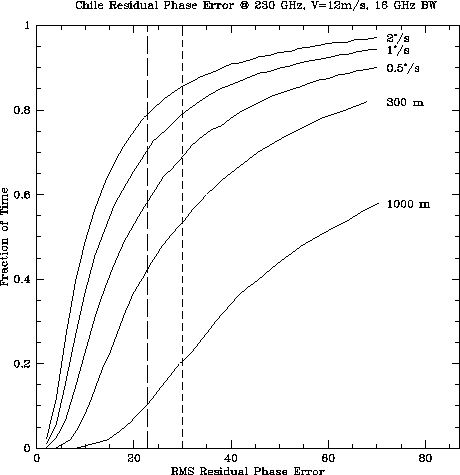
Figure 1: Cumulative distributions of residual phase errors at 60 degree elevation
after fast switching with 16 GHz bandwidth at Chajnantor for three
different switching speeds. Distributions of uncorrected atmospheric
phase fluctuations on 300 m and 1000 m baselines are show for
comparison. The two dashed vertical lines represent the 30 degree rms phase
limit required at elevation angle of 60 degrees, and 23 degrees rms phase, which translates
to 30 degrees rms phase at an elevation angle of 30 degrees.
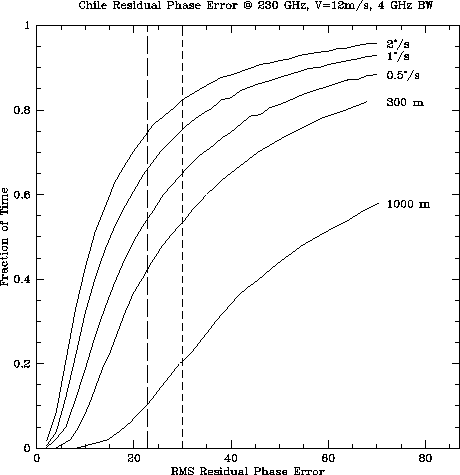
Figure 2: Cumulative distributions of residual phase errors after fast switching
with 4 GHz bandwidth at Chajnantor for three different switching speeds.
Distributions of uncorrected atmospheric phase fluctuations on 300 m
and 1000 m baselines are show for comparison.
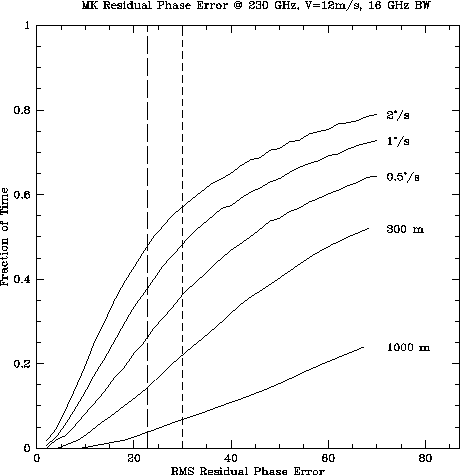
Figure 3: Cumulative distributions of residual phase errors after fast switching
with 16 GHz bandwidth at the Mauna Kea VLBA site
for three different switching speeds.
Distributions of uncorrected atmospheric phase fluctuations on 300 m
and 1000 m baselines are show for comparison.
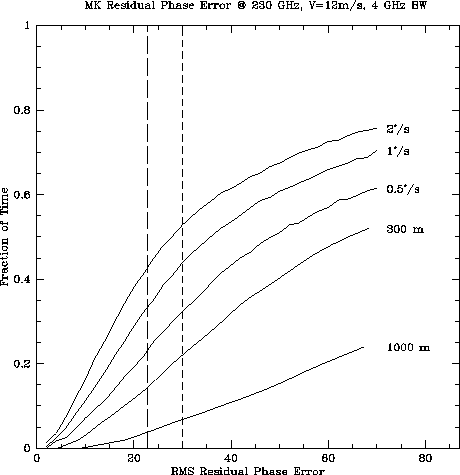
Figure 4: Cumulative distributions of residual phase errors after fast switching
with 4 GHz bandwidth at the Mauna Kea VLBA site
for three different switching speeds.
Distributions of uncorrected atmospheric phase fluctuations on 300 m
and 1000 m baselines are show for comparison.
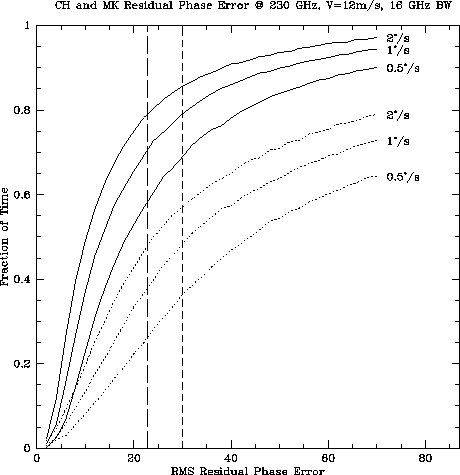
Figure 5: Comparison of cumulative distributions of residual phase errors
after fast switching with 16 GHz bandwidth at Chajnantor and at Mauna Kea.
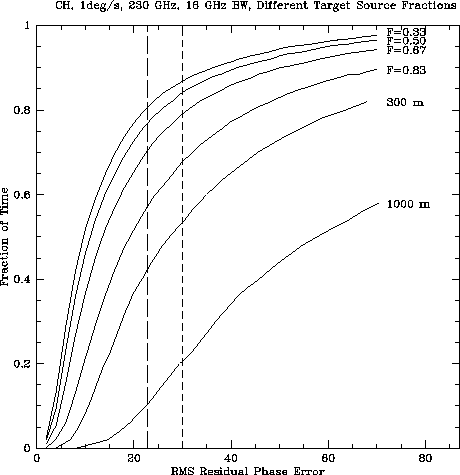
Figure 6: Cumulative distributions of residual phase errors
after fast switching at 230 GHz with 16 GHz bandwidth at Chajnantor
for varying fractions of time spent integrating on the target source.
Since the integration time on the calibrator is fixed, smaller fractions
on the target mean faster cycles.
Distributions of uncorrected atmospheric phase fluctuations on 300 m
and 1000 m baselines are show for comparison.
References
Holdaway, M.A., and Ishiguro, Masato, 1995, MMA Memo 127,
``Dependence of Tropospheric Path Length Fluctuations on Airmass.''
Holdaway, M.A., and Owen, F.N., 1995, MMA Memo 126,
``A Test of Fast Switching Phase Calibration with the VLA at 22 GHz.''
Holdaway, M.A., Ishiguro, Masato, and Morita, K.-I., 1995, MMA Memo ???,
``Analysis of the Spatial and Temporal Phase Fluctuations Above
Nobeyama.''
Holdaway, M.A., Radford, Simon J.E., Owen, F.N., and Foster, Scott M.,
1995, MMA Memo 129, ``Data Processing for Site Test Interferometers.''
Holdaway, M.A., Radford, Simon J.E., Masson, C., Owen, F.N., and Foster, Scott M.,
1995, MMA Memo ???, ``Phase Stability Comparison of the VLBA and Millimeter Valley
Mauna Kea Sites.''